
As of March 2025, leading technology companies—Google, IBM and Microsoft —have made significant progress in their respective quantum computing roadmaps, each achieving significant milestones that bring us closer to practical quantum applications. While these companies share a common objective of reducing quantum error correction, their approaches and methodologies differ. Google and IBM primarily utilize superconducting qubits built upon quantum dots (artificial atoms), whereas Microsoft focuses on topological qubits using Majorana particles, exotic quantum particles expected to enhance resilience to errors. Let’s take a closer look at each company’s quantum roadmap and their achievements so far.
What is Quantum Error Correction ?
Quantum error correction (QEC) is a foundational concept in quantum computing, designed to protect fragile quantum information from errors. Qubits — the fundamental units of quantum computers — can easily lose their state through interactions with the environment (temperature fluctuations, or magnetic fields), a process called decoherence. When this happens, the quantum state “collapses”, meaning the stored quantum information is lost. As a result, the entire computation on a quantum computer becomes corrupted, and the output is no longer reliable (see the Shor’s 1995 paper). This susceptibility to errors makes it difficult to perform long, complex calculations accurately.
This is where QEC comes in. Instead of storing information in a single physical qubit, QEC encodes the information across several entangled physical qubits to create a more stable logical qubit. Because the information is spread out, losing one qubit doesn’t destroy the computation. The system can reconstruct the original quantum state, making the data more resilient to noise and errors.
Shor’s pioneering work on QEC, specifically his nine-qubit code, introduced a method to use redundant physical qubits to protect a single logical qubit. The key insight is that the full information of a quantum state is not stored in any single qubit but is instead encoded in the entanglement and collective state of multiple qubits. This redundancy allows QEC to detect and correct errors caused by decoherence, enabling reliable computation even in the fragile environment of a quantum computer.
But even with quantum error correction (QEC), errors caused by decoherence are inevitable. The central challenge is accurately detecting these errors in real-time and performing corrections much faster than the rate at which they occur.
This raises the question of whether conventional or topological qubits will provide the better path to a large-scale, fault-tolerant quantum computer. Conventional qubits are functional at small scales but face significant scalability challenges, as they require a high overhead of QEC (large number of physical qubits to create a stable logical qubit). Topological qubits, in theory, offer greater robustness and could reduce this overhead, but they’re still at a very early stage, with many challenges that are likely to emerge along the way…
Why is this important? Because fault-tolerant, scalable quantum computing relies on mitigating the effects of errors caused by decoherence. Without it, running long and complex quantum algorithms would be impossible. But the road is still long, and there is much fundamental work to be done. Let’s explore the key milestones on the current quantum roadmap of big tech companies.
Microsoft: Building topological Quantum Computers

Recently, Microsoft’s quantum computing journey gained significant attention with a breakthrough—the introduction of Majorana 1, the world’s first quantum chip as claimed by Microsoft. The quantum chip leverages the unique properties of exotic quantum particles known as Majorana fermions. Microsoft Azure Quantum and Collaborators have claimed to have detected Majorana particles in a topological phase, the groundwork for Majorana-based topological quantum computer. However, their findings have also sparked skepticism about the experimental evidence, raising questions about the validity of the topological test (see e.g. this Nature’s post).
The reproducibility issue of Majorana-based experiments seems to be a well known issue. Back in 2021, Nature published a retraction note regarding a 2018 paper led by researchers from Microsoft station and Delft University of Technology (The Netherlands), which initially claimed the observation of quantized Majorana modes. The retraction followed concerns over the validity of the experimental findings as discussed in this Nature’s post. This highlights the challenges and uncertainties in Majorana research, a field that remains highly speculative. Therefore, more experimental evidence is needed to verify their existence and establish their role in quantum computing.
Despite all the skepticism, Majorana states are believed to offer an inherent protection against loss of quantum information (decoherence). Their successful detection would be a crucial step towards building more robust and scalable quantum computers.
What’s Next ?
Microsoft’s quantum roadmap focuses on scalable quantum correction error, starting with building tetron, a single-qubit device. This progresses to a two-qubit device to demonstrate entanglement and, ultimately, an eight-qubit array, in which quantum error detection will be implemented on two logical qubits. This marks the completion of Milestone 2, a significant achievement in their development.
Google: Building a long-lived logical qubit
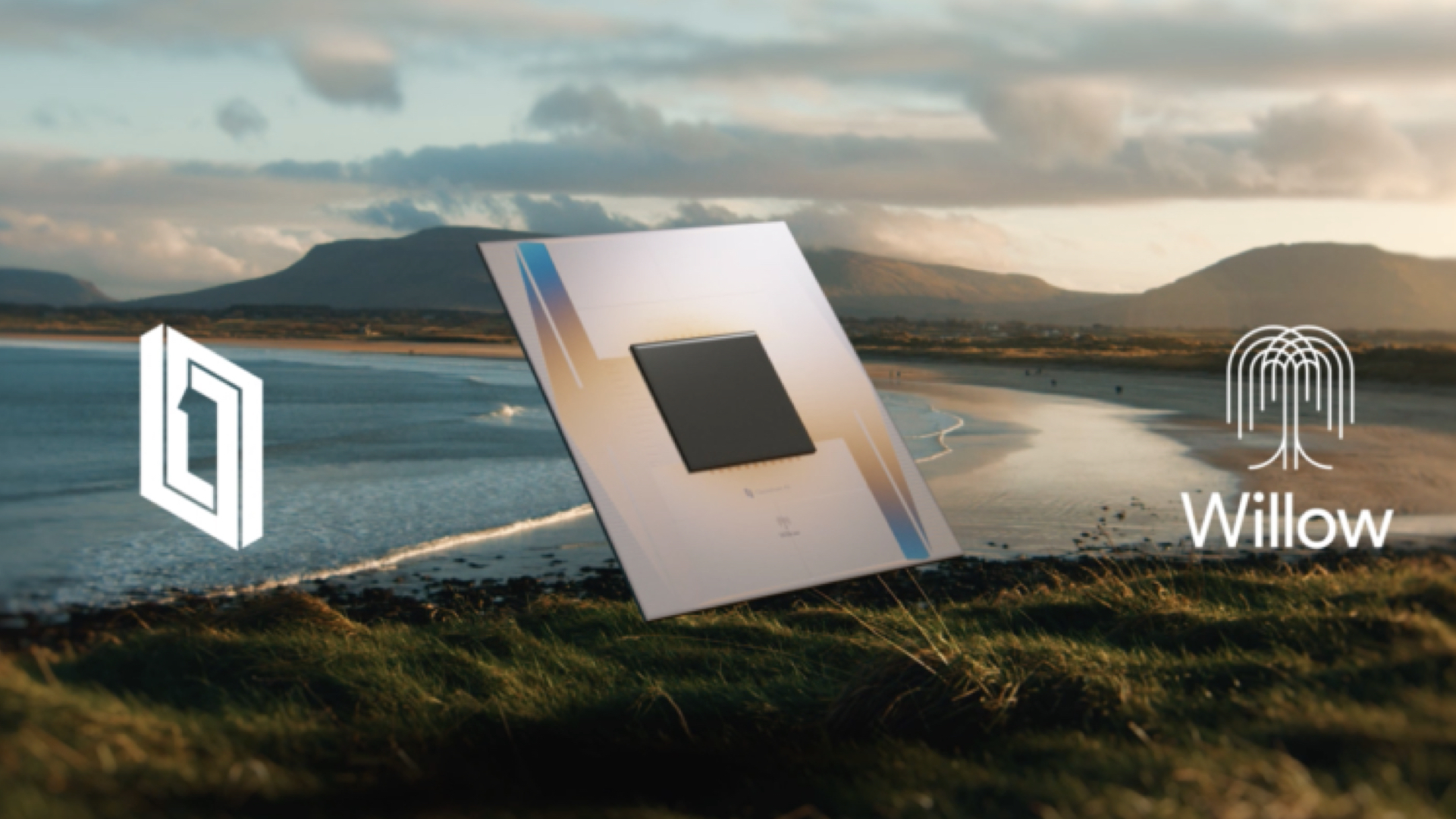
Google’s quantum computing journey gained widespread attention in December 2024 when Google Quantum AI and Collaborators achieved a major breakthrough in quantum error correction, demonstrating exponential suppression of errors as more qubits were added. This was performed on the newest generation of superconducting-based qubit processors – Willow processors (72-qubit and 105-qubit). This marked a pivotal moment in quantum computing, as Willow performed a task under five minutes that would take the most powerful supercomputers 10²⁵ years—a million times the universe’s age—to complete, as reported here.
In their latest research, Google Quantum AI focuses on quantum error correction by combining multiple physical qubits into a logical qubit, significantly reducing the logical error rate as the number of qubits increases. One of the challenges here is accurately recording errors in real-time and correcting them quickly, as superconducting qubits perform operations extremely fast, typically within 10 to 100 nanoseconds.
What’s Next ?
Google’s quantum roadmap sets the Milestone 3 at achieving an error rate of 10⁻⁶, which would require 1,457 physical qubits. This marks a critical step toward fault-tolerant quantum computing.
IBM: Developing the quantum-centric supercomputer

IBM Quantum’s journey gained momentum slightly ahead of Google Quantum AI, marked by their major breakthrough in quantum error correction: a significant reduction in qubit requirements for quantum error correction.
In their latest research, IBM Quantum has demonstrated a more efficient way to protect quantum information from errors. Their approach allows 12 logical qubits—units of quantum information—to be preserved for nearly one million cycles using only 288 physical qubits. In comparison, this would require nearly 3,000 physical qubits using conventional methods. Their findings will allow transitioning from running quantum circuits with thousands gates to millions and even billions of gates, as reported in the IBM’s post, thus making large-scale, fault-tolerant quantum computing more practical in the near future.
What’s Next ?
IBM’s quantum roadmap focuses on developing the quantum-centric supercomputer by 2025 through integrated modular processors, middleware, and quantum communication. On the other hand, IBM aims at simplifying quantum computing by abstracting quantum circuits into user-friendly quantum functions and Qiskit patterns.
References
- Scheme for reducing decoherence in quantum computer memory, Peter W Shor, Phys. Rev. A 52, R2493(R) (1995). https://doi.org/10.1103/PhysRevA.52.R2493
- Quantum error correction below the surface code threshold, Google Quantum AI and Collaborators, Nature 638, pages 920–926 (2025). https://www.nature.com/articles/s41586-024-08449-y
- High-threshold and low-overhead fault-tolerant quantum memory, Sergey Bravyi et al., Nature 627, pages 778–782 (2024). https://www.nature.com/articles/s41586-024-07107-7
- InAs-Al hybrid devices passing the topological gap protocol, Morteza Aghaee et al. (Microsoft Quantum), Phys. Rev. B 107, 245423 (2023). https://journals.aps.org/prb/abstract/10.1103/PhysRevB.107.245423
- Interferometric single-shot parity measurement in InAs–Al hybrid devices, Microsoft Azure Quantum et al. Nature 638, pages 651–655 (2025). https://www.nature.com/articles/s41586-024-08445-2
- RETRACTED ARTICLE: Quantized Majorana conductance, Hao Zhang et al., Nature 556, pages74–79 (2018). https://www.nature.com/articles/nature26142
- Retraction Note: Quantized Majorana conductance, Hao Zhang et al., Nature 591, pageE30 (2021). https://www.nature.com/articles/s41586-021-03373-x
- Data repository accompanying retraction of “Quantized Majorana conductance”, Hao Zhang et al., Zenodo. (2021). https://zenodo.org/records/4545577
- Unpaired Majorana fermions in quantum wires, A Yu Kitaev, Physics-Uspekhi 44, 131 (2001). https://iopscience.iop.org/article/10.1070/1063-7869/44/10S/S29