
Quantum physics provides a framework for describing phenomena at atomic and subatomic scales—realms far beyond the reach of classical physics. Despite its counterintuitive nature, it predicts these phenomena with remarkable accuracy, and it also allows us to make incredibly precise measurements that go beyond what’s possible with classical methods. By using special quantum techniques, scientists can now track certain pairs of properties—like position and momentum—that normally can’t be measured accurately at the same time. This breakthrough could lead e.g. to better sensors and new technologies, pushing the limits of what’s possible in the science of quantum measurement (see e.g. here).
On the other hand, this precision is not only essential for simulating the physical world but also for deepening our fundamental understanding of nature. As Richard Feynman famously stated:
“…if you want to make a simulation of nature, you’d better make it quantum mechanical” (Simulating Physics with Computers, p. 486).
The Crisis in Classical physics
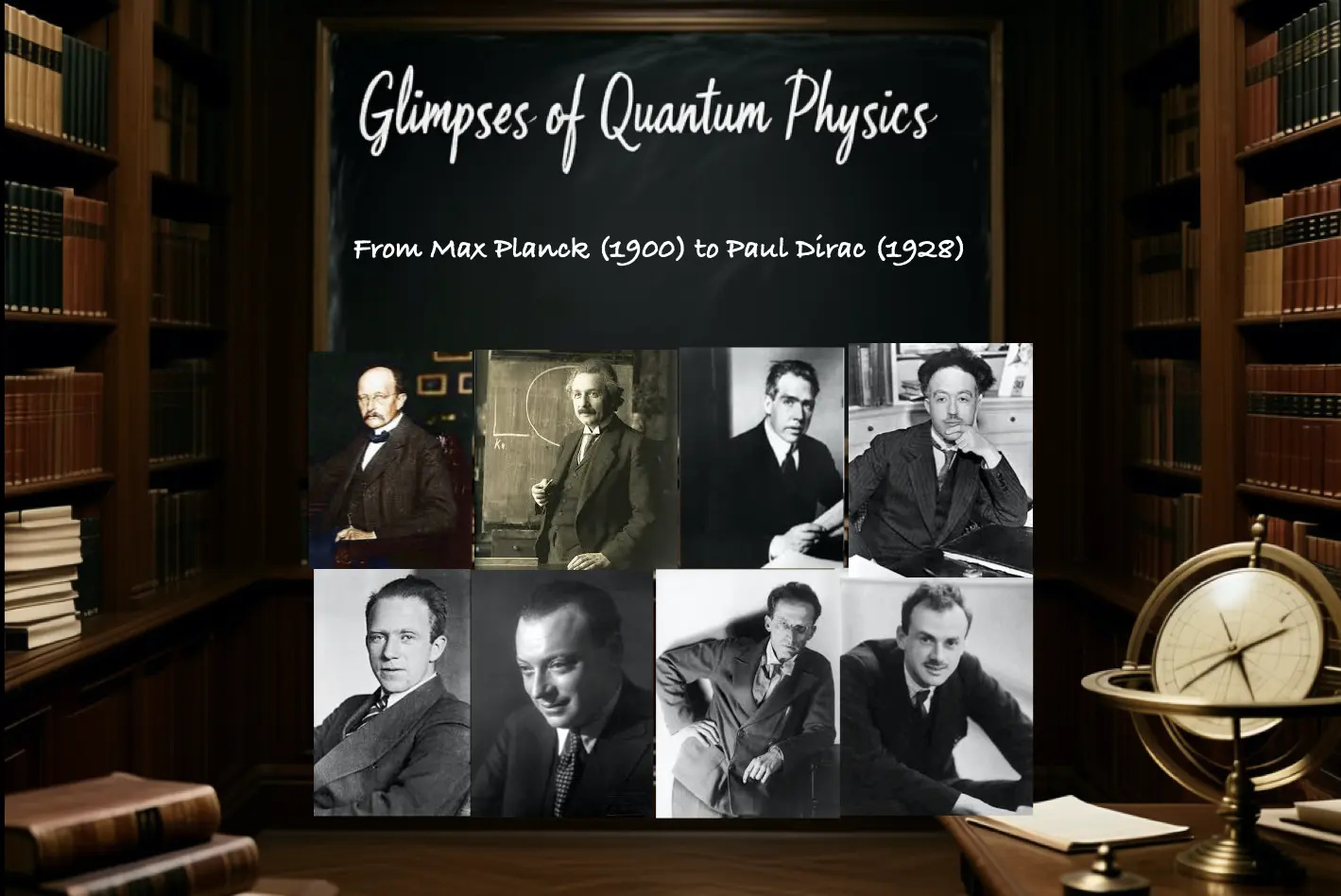
The story behind quantum physics began about 125 years go, when classical physics failed to explain the observed spectrum of black-body radiation—a breakdown dramatically known as the ultraviolet catastrophe. Out of this crisis emerged groundbreaking ideas from Max Planck, Albert Einstein, Niels Bohr, and others, who began to reveal the “why” behind nature’s counterintuitive behavior.
Max Planck‘s introduction of quantized energy in 1900—the idea that energy is not continuous but comes in discrete packets called quanta—marked the birth of quantum theory. This radical step revealed the limits of classical physics and opened a new era in theoretical physics. Over the subsequent 25 years, physicists added a series of heuristic corrections to classical physics, an approach that would later be known as the old quantum theory (1900–1925). Albert Einstein then advanced the Planck’s hypothesis in 1905 by proposing that light itself is composed of quanta (photons), using it to explain the photoelectric effect. Later on, Niels Bohr applied the concept of quantization to atomic structure in his 1913 model, which described electrons occupying specific, quantized energy levels.
Then came a pivotal insight from Louis de Broglie in 1924. He introduced the wave theory of matter known as the de Broglie hypothesis, which states: every material particle of mass m moving with a velocityv can be described by a series of waves of a wavelength λ given by the formula λ=h/mv, where ℎ is Planck’s constant. This wave nature of matter provided the essential explanation for the quantization of energy levels in Bohr’s model (see here for more details).
The Quantum Revolution
The revolutionary idea of wave-particle duality set the stage for the next great leap. In 1925, Werner Heisenberg introduced matrix mechanics — a way to describe quantum systems using matrix representation of physical properties of particles (e.g. position and momentum). This formulation was considered as a new mathematical framework that laid the foundation of quantum mechanics. Later that same year, Wolfgang Pauli proposed the exclusion principle, which states that no two identical fermions (like electrons) can occupy the same quantum state simultaneously. In other words, for instance, two electrons cannot have all four of their quantum numbers identical—these being: n, the principal quantum number; ℓ, the azimuthal quantum number; mℓ, the magnetic quantum number; and ms, the spin quantum number. This insight not only explained the structure of the periodic table and atomic spectra but also revealed a profound quantum rule governing matter at its most fundamental level.
Around the same time (1926), Erwin Schrödinger developed his famous wave equation that governs the wave function of a quantum system, offering an alternative and more intuitive formulation—wave mechanics. Though different in form, both approaches described the same underlying reality. Together, they became the pillars of modern quantum physics. An extension of quantum mechanics into the relativistic regime was achieved later on by Paul Dirac through his 1928 Dirac equation, which also predicted the existence of antimatter (positron).
Legacy and the Pursuit of Unity
These foundational breakthroughs rapidly reshaped modern physics, a contribution recognized by the Nobel Committee when it awarded the prize to Planck (1918), Einstein (1921), Bohr (1922), De Broglie (1929), Heisenberg (1932), Schrödinger and Dirac jointly (1933), and Pauli (1945).
The ambition driving these pioneers extended even further: the dream of building a unified framework that could encompass not only quantum physics but also gravity, electromagnetism, and the nuclear forces—a pursuit that continues today as unified field theory.
References
- Quantum mechanics 100 years on: an unfinished revolution https://www.nature.com/articles/d41586-025-00014-5
- Quantum-Enhanced Measurements: Beating the Standard Quantum Limit https://www.science.org/doi/10.1126/science.1104149
- Quantum-enhanced multiparameter sensing in a single mode https://www.science.org/doi/10.1126/sciadv.adw9757
- On the quantum-theoretical reinterpretation of kinematic and mechanical relationships https://link.springer.com/article/10.1007/BF01328377
- On the Connexion between the Completion of Electron Groups in an Atom with the Complex Structure of Spectra http://www.fisicafundamental.net/relicario/doc/Pauli_1925.pdf
- Quantization as an eigenvalue problem https://onlinelibrary.wiley.com/doi/10.1002/andp.19263840404