
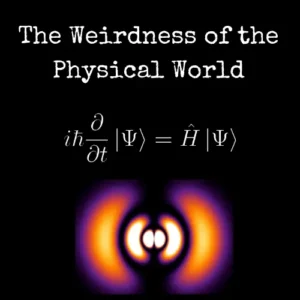
Quantum physics reveals the weirdness that naturally originates from processes occurring at extremely small scales (atomic and subatomic). It is perceived weird as human perception clashes with a reality – called quantum realm – that doesn’t align with the rules of the classical world we are grounded in. Yet, this weirdness can appear at the macroscopic scale and is predictable with an accuracy far beyond the reach of classical physics. In this post, I explore this quantum strangeness through its most famous thought experiments: the Einstein-Bohr debate, Schrödinger’s Cat, and Quantum Entanglement.
Dual reality of the physical world
One of the weirdest aspects of the physical world is the dual behaviour of quantum particles. For instance, a quantum particle can exist in two positions simultaneously, or have its spin pointing in two different directions at the same time—a reality that completely defies classical intuition. This counter-intuitive reality can be illustrated by a thought experiment based on the well-known double-slit experiment.
Double-slit experiment is one of the most powerful paradigms for exploring the weirdness of nature through the laws of quantum physics. Initially performed about 225 years ago by Thomas Young to demonstrate the wave nature of light, the experiment took on a new life in the 20th century. Subsequent versions using particles like electron, atoms and even heavy molecules demonstrated the the startling reality of wave-particle duality. This was pushed even further with atomic-scale slits (a microscopic version of double-slit experiment) realized using molecules such as H₂, O₂, and HD⁺.
But beyond these demonstrations… the thought experiment was adopted to address long-standing (philosophical) debates, most notably the famous Einstein-Bohr debate on wave-particle duality and complementarity (but more generally on the completeness of quantum mechanics).
Einstein–Bohr debate
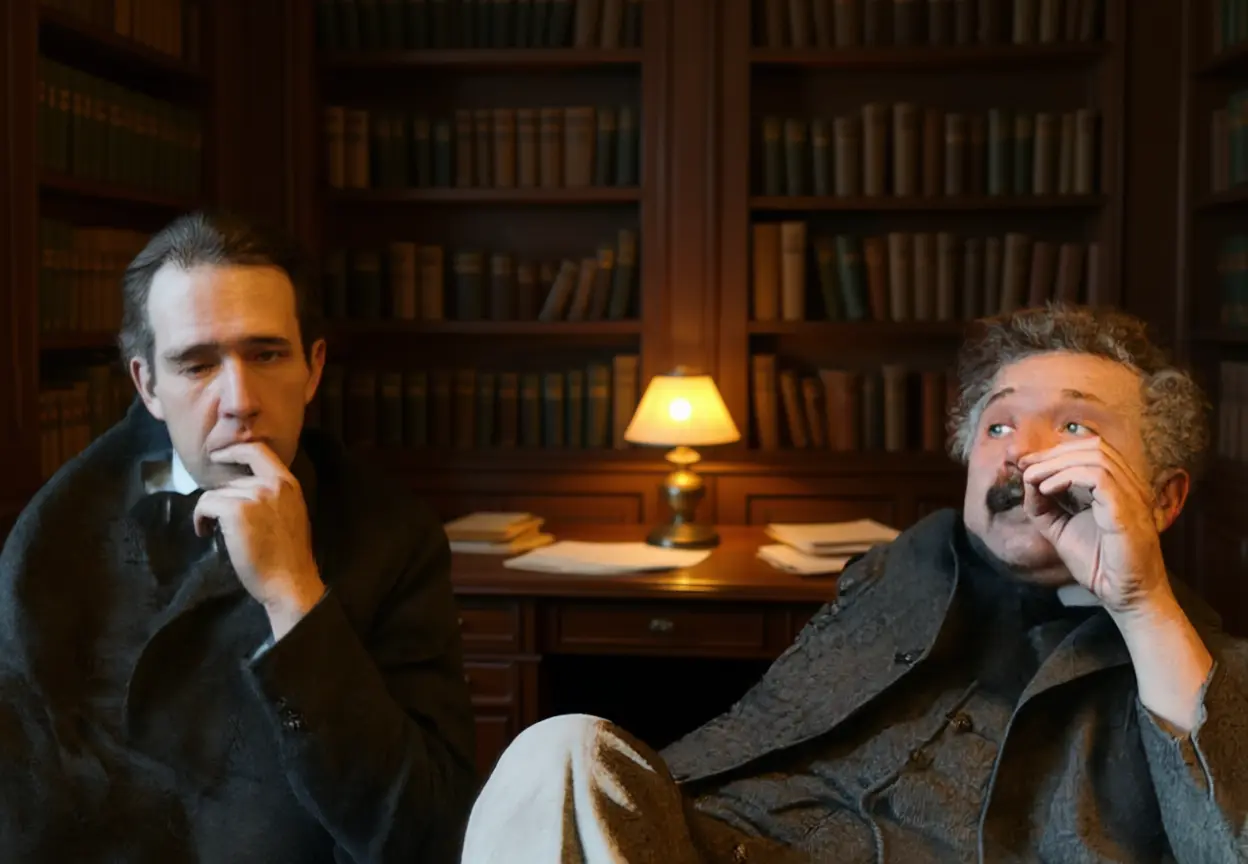
At the heart of the famous Einstein-Bohr debate was Einstein’s deep concern that quantum mechanics had abandoned a causal account of events in space and time. Einstein expressed (quoted)
“deep concern over the extent to which causal account in space and time was abandoned in quantum mechanics“.
Here, “causal account in space and time” refers to the classical idea that any physical event is the direct result of a prior cause that happens in specific locations (space) and moments (time), and that we can track how one event leads to another in a deterministic way.
Einstein’s concern was reflected, in particular, in a specific thought experiment to challenge quantum mechanics. His argument was rooted in his belief in determinism within quantum mechanics. He argued that one could determine the pathway of each individual particle passing through a double-slit setup by measuring the recoil momentum transferred to the first slit used for diffraction. Such a measurement, he proposed, would simultaneously ensure the particle wave coherently illuminates the double-slit assembly while revealing its particle-like path.
Bohr’s rebuttal was that the entire setup — the particle and the slits together — forms a single quantum system. Measuring which slit the particle passes through inevitably disturbs this system, destroying the interference pattern. This illustrates Bohr’s principle of complementarity, which states that you can observe either the wave-like behavior (and see interference) or the particle-like behavior (and know the path), but never both at the same time.
Experimental realizations of a microscopic double-slit experiment, where the two slits are materialized by identical atomic sites, have been conducted to address the Einstein-Bohr debate. The obtained results were found to be consistent with Bohr’s argument, confirming that a quantum mechanical description of the experimental setup is appropriate to describe the observed quantum phenomenon (quantum interference).
Yet, it was surprisingly shown that Einstein’s original viewpoint of the thought experiment is still possible by adopting a classical description of the slits, and incorporating a delocalized nonclassical interaction (as discussed here). Despite this, Einstein’s argument paved the way for a new era of experiments designed to test the principle of local realism. Although his specific vision was ultimately ruled out by experiments like those of Alain Aspect (who earned the 2022 Nobel Prize for this work), Einstein’s persistent criticism forced a deeper understanding of quantum theory and highlighted just how strange the quantum world truly is.
Schrödinger’s Cat experiment
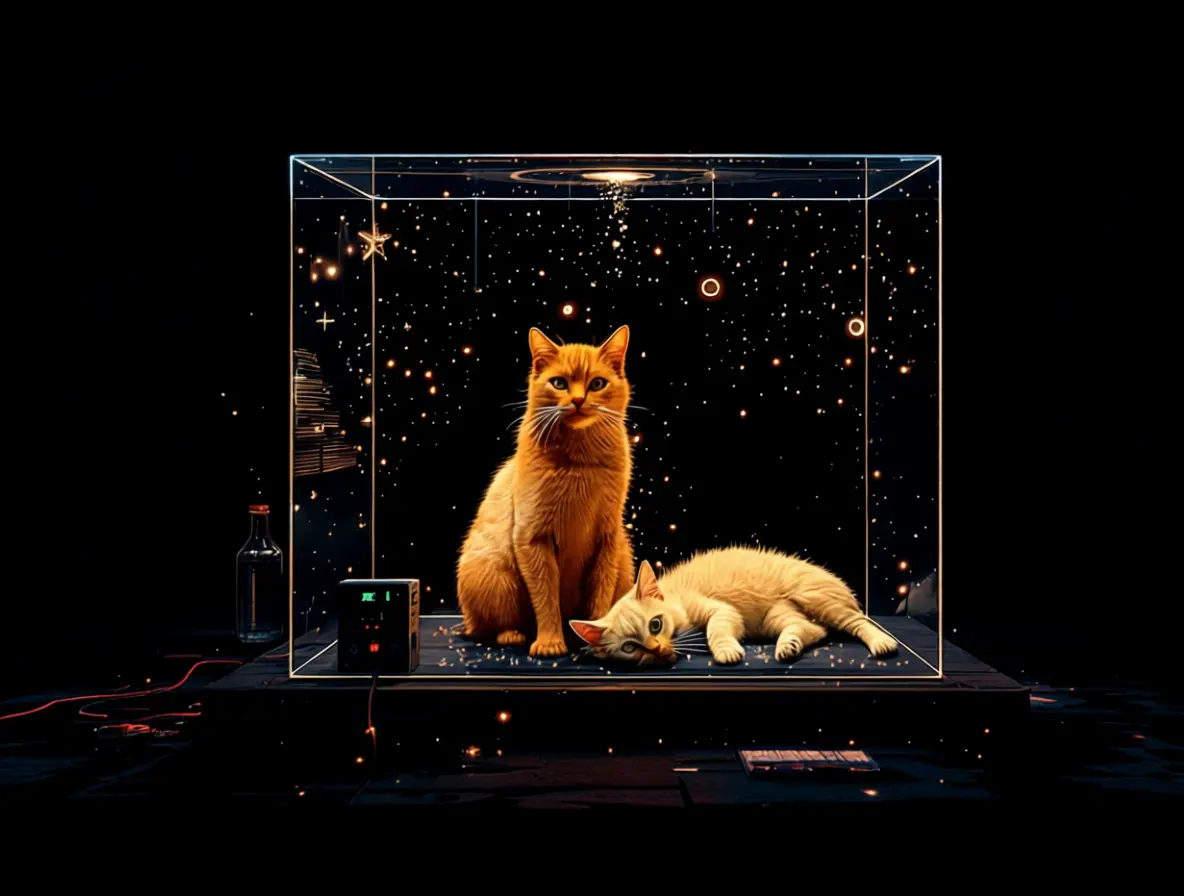
In the continuity of Einstein-Bohr debate, Schrödinger proposed what was known as the Schrödinger’s Cat thought experiment. He designed it to show that applying the principle of superposition to a macroscopic object led to a logically absurd outcome—a cat both alive and dead (cf. Fig. 3).
In this experiment, Schrödinger imagined a scenario where a macroscopic system, a cat, was coupled to a single atom. The atom, initially prepared in an excited state, could spontaneously decay to its ground state by emitting a photon. This emission would then activate a mechanism to kill the cat. After a time equal to half the atom’s excited-state lifetime, the atom evolves into a superposition of two states: one state corresponding to a decayed atom (the cat is dead), the other to a non-decayed atom (the cat is still alive). At this point, the atom and cat become entangled, leaving the cat suspended between two realities: life and death. Here, any attempts to determine which reality the cat is in (by performing a measurement) leads to the collapse of the superposition (alive+dead) into a single reality, thus destroying the quantum state (see also S. Haroche’s 2012 Nobel Lecture).
Quantum entanglement
Beyond the specific outcome of Schrödinger’s Cat, the thought experiment’s legacy also lies in its use of quantum entanglement to highlight the paradoxical implications of applying quantum superposition to a macroscopic object. In the experiment, the fate of the cat becomes entangled with the state of a radioactive atom. This means the atom and the cat form a single, non-separable system; their states are correlated so that the ‘alive’ cat is tied to a non-decayed atom and the ‘dead’ cat is tied to a decayed atom (cf. Fig. 3).
In essence, the Schrödinger’s Cat thought experiment defines the problem of measurement; measuring a quantum system requires entangling it with a measuring device. In other words, when two systems are entangled, measuring one instantly reveals the state of the other; the first system serves as a measuring device for the second.
This bizarre but fundamental phenomenon, where distinct systems become linked in a quantum way, is the engine of the paradox. Beyond this, entanglement is also the key to understanding decoherence— the process that explains how the classical appearance of the macroscopic world emerges from the quantum realm. It is thus a cornerstone of modern physics.
Conclusion
These thought experiments, initially conceived to address foundational problems in quantum physics, have evolved into a powerful engine for discovery and innovation. Their legacy is demonstrated not only by Nobel Prizes recognizing the experimental verification of their predictions but also by their direct role in spawning modern technologies. This is clear from recent Nobel Prizes, which celebrate this success: For example, the 2012 Nobel Prize for measuring and manipulating quantum particles, the 2022 Nobel Prize for experiments with entangled photons that pioneered quantum information science, and the 2023 Nobel Prize for generating attosecond light pulses to probe electron motion, and this year’s 2025 Nobel Prize for the discovery of macroscopic quantum tunneling; all form the foundation of emerging quantum technologies, including quantum computers, quantum cryptography, quantum sensors, and quantum imaging, proving that the most abstract quantum puzzles can lead to powerful and practical inventions.
References
- The Puzzle Of Quantum Reality https://www.npr.org/sections/13.7/2018/03/20/595286482/the-puzzle-of-quantum-reality
- Einstein–Bohr recoiling double-slit gedanken experiment performed at the molecular level https://www.nature.com/articles/nphoton.2014.289
- N. Bohr, in Albert Einstein: Philosopher Scientist. Page 201 https://ia801902.us.archive.org/6/items/albert-einstein-philosopher-scientist/albert-einstein-philosopher-scientist.pdf
- Einstein and the EPR Paradox https://www.aps.org/archives/publications/apsnews/200511/history.cfm
- Photons detected without being destroyed https://www.nature.com/articles/nature.2013.14179
- Nobel Lecture: Controlling photons in a box and exploring the quantum to classical boundary https://journals.aps.org/rmp/pdf/10.1103/RevModPhys.85.1083
- Colloquium: Manipulating quantum entanglement with atoms and photons in a cavity https://journals.aps.org/rmp/pdf/10.1103/RevModPhys.73.565